DEEP-DOMAIN SCIENTIFIC AGENT ARCHITECTURE · #0 FOUNDATION

AI for EmpiricalScientific Computing

Digitize the domain environment & expert methodology.
Zero-hallucination science from massive data to instant insight.

In deep verticals like semiconductor fabs, precision medicine, and aerospace, general LLMs are domain outsiders—tacit know-how is not on the public web, and every problem is tightly coupled to field roles, tool physics, proprietary data, and SOPs.

Core Distinction: General agents do simple tool calls in common-sense settings. Our architecture digitizes a high-barrier industry’s complete field environment (People · Machines · Data) and expert methodology (SOPs & Checks)—automating scientific data production and engineering insights under zero-hallucination, massive-data, full-provenance, and visual-auditability constraints.
Explore the 6 problem spaces & architecture

Built for High-Barrier Verticals · Semiconductor Fab · Clinical & Precision Medicine · Aerospace Manufacturing

AGENT ARCHITECTURE & PROBLEM SPACE

How We Solve What General Agents Cannot

Three-Layer Digitized Foundation · Governed Two-Speed Loop · Six Core Capabilities

L1 · ScenarioSpecPeople · Machines · Data
Field Environment & Context

Digitizes role responsibilities & approval gates, machine measurement physics, spatial coordinates, and target vs. reference baselines.

L2 · Expertise PackageRails · Methods · Checks
Expert Troubleshooting Methodology

Encodes tacit engineering SOPs (e.g., wafer edge exclusion, chamber checks, denominator rules) into governed, non-skippable execution rails.

L3 · Scientific PipelineMethodDefinition M01–M15
Deterministic Domain Operators

Models propose a Canonical Plan; 100% of numerical statistics & physical quantities are computed by multi-pass deterministic operators.

01Deep Domain & Environment

General LLMs lack fab/clinical SOPs and guess blindly.

Scenario + Expertise Package + Rails Kernel enforce expert workflows.

02Massive Data (10s–100s GB)

Raw wafer maps, point clouds & waveforms overflow context windows.

Control/Data separation: Scoped View + Query Catalog over engine slicing.

03Zero-Tolerance Scientific Compute

Probabilistic text generation cannot guarantee physical or statistical rigor.

Canonical Plan + 21-Pass deterministic operators; zero LLM math guessing.

04Full Reasoning & Provenance

Free-text answers cannot prove numbers match actual executions.

Cryptographic receipts, denominator definitions & Slot Verification.

05Interactive Visual Auditability

Ad-hoc charts suffer from binning distortion or chart-number mismatch.

Source-locked charts & underlying arrays with drill-down & state restore.

06Governed Two-Speed Loop

Heavy batch compute needs approval; follow-up Q&A needs sub-second speed.

Analysis Agent (immutable assets) + Inquiry Agent (instant QueryPlan).

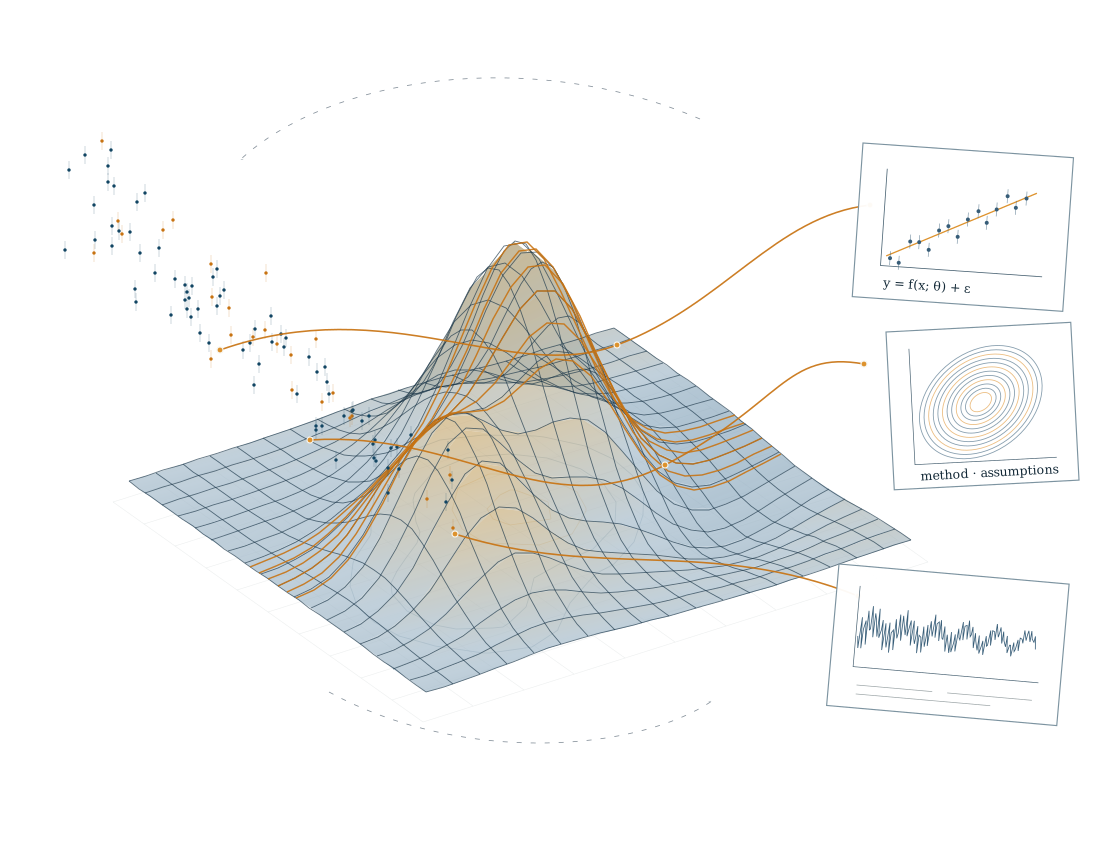
A conceptual scientific plate connecting observations, a computational surface and inspectable evidence. This illustration does not show experimental results or software architecture. Observations (People · Machines · Data) Deterministic 21-Pass Pipeline Auditable Evidence & Instant Inquiry
Digitized Environment (Scenario · Expertise · Pipeline)
Control/Data Separation & 21-Pass Deterministic Compute
Slot-Verified Provenance · Visual Audit · Two-Speed Loop

01Architectural foundation (#0 premise)

MANGO AI / ARCHITECTURE

Why general LLMs fail in deep verticals—
and how we digitize the field.

In common-sense office tasks, pretrained models already know the workflow. In semiconductor fabs, clinical medicine, and aerospace, the base model is a domain outsider.

Critical troubleshooting know-how—how PE, PIE, and YE engineers coordinate, why wafer edge exclusion is mandatory before defect-density math, or which chamber parameter to inspect when a ring or center-cluster pattern appears—never lives on the public web. Every problem is tightly coupled to a proprietary field environment of People (roles & approvals), Machines (measurement physics & tool limits), Data (spatial coordinates & target/reference baselines), and Methodology (troubleshooting SOPs & statistical denominators).

Instead of trying to smear domain knowledge into black-box model weights via fine-tuning, our architecture explicitly digitizes the field environment and expert methodology across three layers: ScenarioSpec (field context), Expertise Package (governed rails, methods & checks), and Scientific Pipeline (MethodDefinition M01–M15 deterministic operators).

High-Barrier Vertical Environment (People · Machines · Data · Methodology)
Three-layer digitized carrier

ScenarioSpec + Expertise Package + Scientific Pipeline

ScenarioSpec (Context)Expertise Package (Rails)21-Pass Operators (Compute)
Replacing fragile black-box fine-tuning with an explicit three-layer carrier that digitizes field context, expert troubleshooting SOPs, and deterministic scientific operators.
  1. 01

    L1 · ScenarioSpec: Digitizes field roles, tool physics, spatial coordinates & reference baselines.

  2. 02

    L2 · Expertise Package: Locks senior engineers’ troubleshooting SOPs & checks into non-skippable rails.

  3. 03

    L3 · Scientific Pipeline: Executes validated domain operators (M01–M15) with zero numerical hallucination.

026 Core Problem Spaces

PROBLEM SPACES & SOLUTIONS

Built for high-barrier,
high-value scientific scenarios.

Our agentic architecture is purpose-built for deep-domain environments that simultaneously demand all six of the following capabilities—where general-purpose agents break down.

01Deep Domain & Environment

Digitize "People · Machines · Data · Methodology"

Pain point: Heavy reliance on internal fab/clinical context and years of tacit troubleshooting know-how; general LLMs guess blindly and skip critical checks. Architectural solution: Scenario + Expertise Package + Rails Kernel turn field context and expert SOPs into governed, non-skippable execution rails.

02Massive High-Dimensional Data

Separate control flow from 10s–100s GB data flow

Pain point: High-res wafer maps, point clouds, full-wafer coordinates, and long waveforms never fit in a context window. Architectural solution: The model only inspects a controlled Scoped View and structured Query Catalog, while the underlying engine slices and computes raw data.

03Zero-Tolerance & Science

100% deterministic 21-pass scientific operators

Pain point: Every statistic, distribution, and physical quantity impacts yield, safety, or clinical diagnosis—zero tolerance for LLM math hallucinations. Architectural solution: Models only interpret goals and propose a Canonical Plan; all numerical values are produced by 21-pass deterministic operators.

04Full Reasoning & Provenance

Cryptographic receipts & slot-level verification

Pain point: Isolated conclusions and free-text generation cannot guarantee that "the number stated is the number computed" or explain exact denominators. Architectural solution: Binds Scientific Method physical definitions, logs every execution receipt, and enforces strict Slot Verification on final answers.

05Visual Auditability

Source-locked charts & interactive drill-down

Pain point: Engineers must visually inspect high-precision distributions, heatmaps, and histograms; ad-hoc charts suffer from binning distortion or state loss. Architectural solution: Charts and underlying distribution arrays are co-generated and bi-directionally locked, supporting click-to-expand, source verification, and exact state recovery.

06Governed Two-Speed Loop

Decouple heavy batch compute from instant Q&A

Pain point: Deep scientific pipelines are compute-heavy and require human approval, while follow-up engineering inquiry demands sub-second interactivity. Architectural solution: Dual-engine decoupling—an Analysis Agent (governed pipeline execution producing immutable assets) + an Inquiry Agent (sub-second multi-turn insights via QueryPlan).

Summary: General agents make simple tool calls in common-sense settings. Our architecture encapsulates a high-barrier industry’s complete field environment and expert methodology—automating scientific data production and engineering insight discovery end to end.

03Evidence & scientific argument

Follow a finding
back to its basis.

A useful scientific explanation connects the question, the method, the calculation and the limits of the conclusion. Explore a small worked example below.

One inspectable result

Observed difference in group means

Calculated from the complete synthetic observations. Open the value to inspect its formula, source data and scientific limits.

A worked scientific exampleSynthetic data · prewritten analytical choices
Illustrative scientific question

Does the observed difference support a persistent change?

Data8 observations in A; 8 in B · a.u.
MethodMeans, their difference and an uncertainty estimate
Open conditionCollection conditions are not established as comparable
Analysis & supporting recordQuestion & available observations
SOURCE OBSERVATIONSGroup A: 8 · Group B: 8Shared declared unit: a.u.OPEN CONDITIONSCollection comparabilityIndependence of observationsTHE SCIENTIFIC QUESTIONDoes the observed differencesupport a persistent change?Separate known inputs from assumptions.
QUESTIONDoes the observed difference support a persistent change?
AVAILABLE DATA8 observations in A; 8 in B · a.u.
OPEN CONDITIONCollection conditions are not established as comparable
Retained basisUnresolved or proposed

01 / Frame

Begin with the scientific question.

Two synthetic groups have different observed means. Does this support a persistent change?

The data share a declared unit. Collection conditions and independence are not established by these values.

Continuing evidence record

  1. FrameQuestion, observations and open conditions retained
  2. PlanNext in the illustration
  3. ComputeNext in the illustration
  4. AssessNext in the illustration
  5. RefineNext in the illustration
  6. ExplainNext in the illustration

An illustrative example, not a live autonomous agent or a performance benchmark. Values are calculated from synthetic observations; plans and assessments are prewritten. Follow-up measurements and revised analyses have not been performed.

04Research exchange

OPEN QUESTIONS

Questions worth
working on together.

We welcome conversations with scientists, engineers and researchers building AI for scientific work.

Read & join the discussion

Articles and topics have permanent pages to read and share.

  1. 01

    How can domain expertise guide method and parameter choices?

  2. 02

    What evidence should remain connected across a long investigation?

  3. 03

    How should we evaluate whether a finding is ready to use?

Community contributions are public. Share material you have permission to publish.

Calculation & evidence record

A result with an inspectable basis.

Choose a reported value to inspect its inputs, method, calculation and limits.